
Published: August 18, 2026 | Updated: August 18, 2026
What Is the Best Time to Renovate Chicago Home Projects?
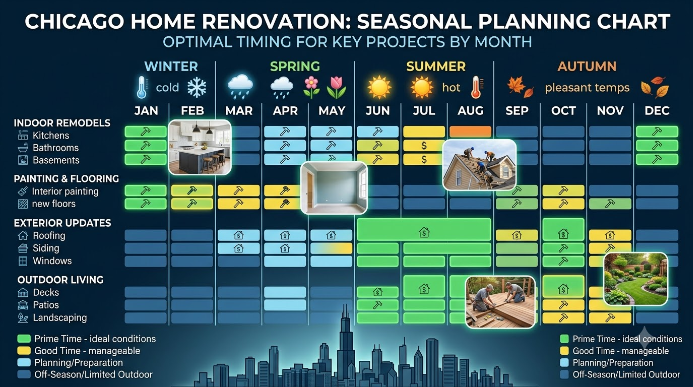
The best time to renovate Chicago home projects depends on where the work happens. Interior work — kitchens, bathrooms, basements — books most easily from January through March, when contractor demand drops. Exterior work — roofing, masonry, concrete, siding — belongs in late spring through early fall, because Chicago’s freeze-thaw cycle governs what can safely cure and seal.
That split is the whole answer, and most homeowners get it backwards. They call in May, when every crew in the city is already committed, and then wait until August for a kitchen that could have been finished in February. Chicago General Contractor connects homeowners with licensed, independent contractors across the city, and the scheduling pattern below reflects how those crews actually plan a year.
Article Overview
- Winter (Jan–Mar): best availability for interior remodels; worst for anything outdoors.
- Spring (Apr–Jun): permit and material lead times stretch; book exteriors now for summer starts.
- Summer (Jul–Aug): peak exterior season, peak competition for crews.
- Fall (Sep–Nov): the narrowest and most valuable window for roofing and masonry.
- Permits, not weather, are the most common cause of a blown start date.
Why Chicago’s Climate Changes the Answer
Chicago sits in a cold, humid continental climate zone with a hard winter and a genuine freeze-thaw cycle. That cycle is not a comfort issue. It is a materials-science constraint that decides whether certain work can be done at all.
Three constraints matter most:
- Concrete and mortar. Likely: standard cold-weather practice treats sustained temperatures below roughly 40°F as the point where concrete and masonry mortar need active protection — heated enclosures, blankets, or admixtures — to cure properly. That protection costs money and adds days. Below freezing, most residential crews simply stop pouring.
- Asphalt shingles. Likely: shingles rely on a heat-activated sealant strip to bond. In cold weather that strip may not seal until the following spring, which leaves the roof vulnerable to wind uplift through a Chicago winter. Emergency roof work happens in January; planned roof replacement should not.
- Exterior paint and coatings. Most exterior coatings carry a minimum application temperature. Painting a Chicago exterior in November is a coin flip against an early cold snap.
Interior work carries none of these constraints. A basement finish or a bathroom gut is temperature-independent once the building envelope is closed, which is exactly why winter is the underused window.
Best Time to Renovate Chicago Home Projects: Season by Season
Winter (January – March): interiors, and the best contractor availability of the year
This is the quiet quarter. Exterior crews are idle or running small jobs, so the same companies bidding your kitchen in June have real calendar space in February. Homeowners in Lincoln Park and Lakeview two-flats often use this window for kitchen and electrical work, since older panels frequently need upgrading before a kitchen addition passes inspection.
What works well in winter: kitchen remodels, bathroom remodels, basement finishing, flooring, interior painting, electrical and plumbing rough-in.
The trade-off: dust and disruption land during the months you are indoors most, and material deliveries can slip during heavy snow. Neither is a reason to wait until spring.
Spring (April – June): the planning season, not the doing season
Spring is when demand spikes and lead times stretch. Every homeowner who spent winter thinking about a deck calls in April. If you want exterior work done in 2026, spring is when you should be signing contracts and pulling permits, not when you should expect crews on site.
Spring is also the right window for anything that reveals winter damage. Water in a basement after the March thaw, tuckpointing gaps that opened over the freeze-thaw cycle, or roof flashing that failed under ice damming — all of it becomes visible now and should be scoped before summer.
Summer (July – August): peak exterior season, peak competition
Summer is when Chicago exterior work actually gets done. Concrete cures without protection, shingles seal on the roof deck, masonry mortar behaves predictably. Additions, garage builds, siding, decks, and driveway work all belong here.
The cost of that certainty is competition. Crews are fully booked, and the flexibility you had in February is gone. A homeowner calling in July for a July start is usually choosing from whoever is available rather than whoever is best.
Fall (September – November): the narrow, valuable window
Early fall is arguably the single best stretch of the year for roofing and masonry in Chicago. Temperatures are moderate, humidity has dropped, and summer’s scheduling crunch has eased slightly. Bungalow belt neighborhoods like Portage Park and Jefferson Park, where brick and tuckpointing work is common, see heavy fall activity for exactly this reason.
The window is narrow. By mid-November the risk of a hard freeze mid-project is real, and any exterior job that has not reached a weather-tight stage becomes a problem. Fall work needs a firm start date and a contractor who will hold it.
Chicago Renovation Timing at a Glance
| Season | Best-fit projects | Contractor availability | Main risk |
|---|---|---|---|
| Jan – Mar | Kitchen, bath, basement, flooring, interior paint | High | Delivery delays in heavy snow |
| Apr – Jun | Scoping, permits, contracts, damage assessment | Falling fast | Booking too late for summer |
| Jul – Aug | Additions, concrete, siding, decks, garages | Low | Limited choice of crew |
| Sep – Nov | Roofing, tuckpointing, masonry repair | Moderate | Early freeze mid-project |
Read that table as a sequencing tool rather than a ranking. There is no single month that is the best time to renovate Chicago home projects across every trade at once, and any contractor who tells you otherwise is describing their own calendar, not your project.
How the Vetting Step Fits Your Timeline
Timing pressure is where homeowners skip due diligence. A crew that can start next week in July is available for a reason, and that reason is worth understanding before signing.
Before a contractor is referred through our network, the checks that matter are the ones you can repeat yourself: an active Illinois license, current general liability and workers’ compensation coverage, and a written scope with a payment schedule tied to milestones rather than dates. Verify licensing directly through the City of Chicago’s contractor lookup rather than taking a number on a business card at face value.
Off-season booking is what makes that verification possible. In February you have weeks to compare three bids. In July you have an afternoon.
Permits Are the Real Schedule Risk
Weather decides what is possible. Permits decide when you actually start. The City of Chicago Department of Buildings requires permits for structural work, additions, and most electrical and plumbing changes, and review timelines vary by permit type and by whether the project sits in a landmark or historic district.
Assumed: current Chicago permit review timelines by project type — I did not verify these against the Department of Buildings this session; confirm at the Department of Buildings before promising a homeowner a start date. Neighborhoods such as Beverly, with historic-district considerations, can add review time that has nothing to do with the season.
The practical rule: back-date from your desired start. If you want a roof replaced in September, permit work should be moving by June. Our full Chicago renovation permit guide walks through which projects need one.
Does Timing Change What a Renovation Costs?
Somewhat, but less than most homeowners hope. Winter interior work can attract more competitive bidding simply because crews want to fill the calendar. That is a real effect, not a guaranteed discount.
Assumed: seasonal pricing differentials for Chicago residential work — I did not source current figures, and no percentage should be published here without a named, current source. Material pricing moves on national supply cycles, not on Chicago’s calendar. For project-level cost ranges, see our guide to home renovation costs in Chicago.
The larger financial effect is not discounting. It is avoiding the rushed hire. Booking off-season gives you time to compare bids, check licensing, and verify insurance — which is the part of the process that actually protects a budget.
How to Decide Your Own Best Time to Renovate Chicago Home Work
Work through four questions in order:
- Is any part of this project outdoors or envelope-related? If yes, the weather window sets your schedule, and everything else fits around it.
- Does it need a permit? If yes, add lead time before the start date you want, not after.
- Can you live in the house during the work? Kitchen and single-bathroom projects are harder in winter, when leaving the house is less appealing.
- How much do you care about contractor choice? If you want a specific crew, book against their off-season, not yours.
Whole-home and multi-room projects often span seasons deliberately: exterior envelope in late summer, interiors through the following winter. Sequencing a residential renovation this way keeps crews working continuously instead of waiting on weather.
Seasonal maintenance planning follows the same logic — see our overview of Chicago home renovations that keep a home looking its best for smaller upkeep projects that fit between larger ones.
Get Matched With a Chicago Contractor
Call +1 (708) 630-1131 to talk through your timeline, or start at Chicago General Contractor to see how the referral network works. We connect you with licensed, independent contractors — we do not perform the work ourselves.
Frequently Asked Questions
Is winter really a good time to renovate in Chicago?
For interior work, yes. Kitchens, bathrooms, basements, and flooring are unaffected by outdoor temperature once the building envelope is sealed, and contractor availability is at its yearly peak between January and March.
What is the worst month to start a renovation in Chicago?
Late November through December for exterior work, because a hard freeze mid-project can stall a job until spring. For interior work there is no genuinely bad month, though holiday scheduling slows deliveries.
How far in advance should I book a Chicago contractor?
Assumed: typical booking lead times vary widely by trade and crew size — confirm with the specific contractor. As a planning default, allow several months ahead of a summer exterior start, and less for winter interior work.
Can roofing be done in Chicago winter?
Emergency repairs, yes. Planned replacement is better deferred, since asphalt shingle sealant strips may not bond properly in cold weather and the roof can stay vulnerable to wind uplift until spring.
Does renovation timing work differently for Chicago condos?
Yes. Condo and HOA buildings often restrict work to weekday hours and require board approval, and many limit elevator or freight access seasonally. Board review adds lead time on top of city permitting.
Reviewed by Donny Zanger, founder of Chicago General Contractor and BuildWrks, a contractor lead-generation platform. Chicago General Contractor is a referral service that vets and connects homeowners with licensed, insured, independent contractors across Chicago’s neighborhoods; it does not perform construction work itself.